
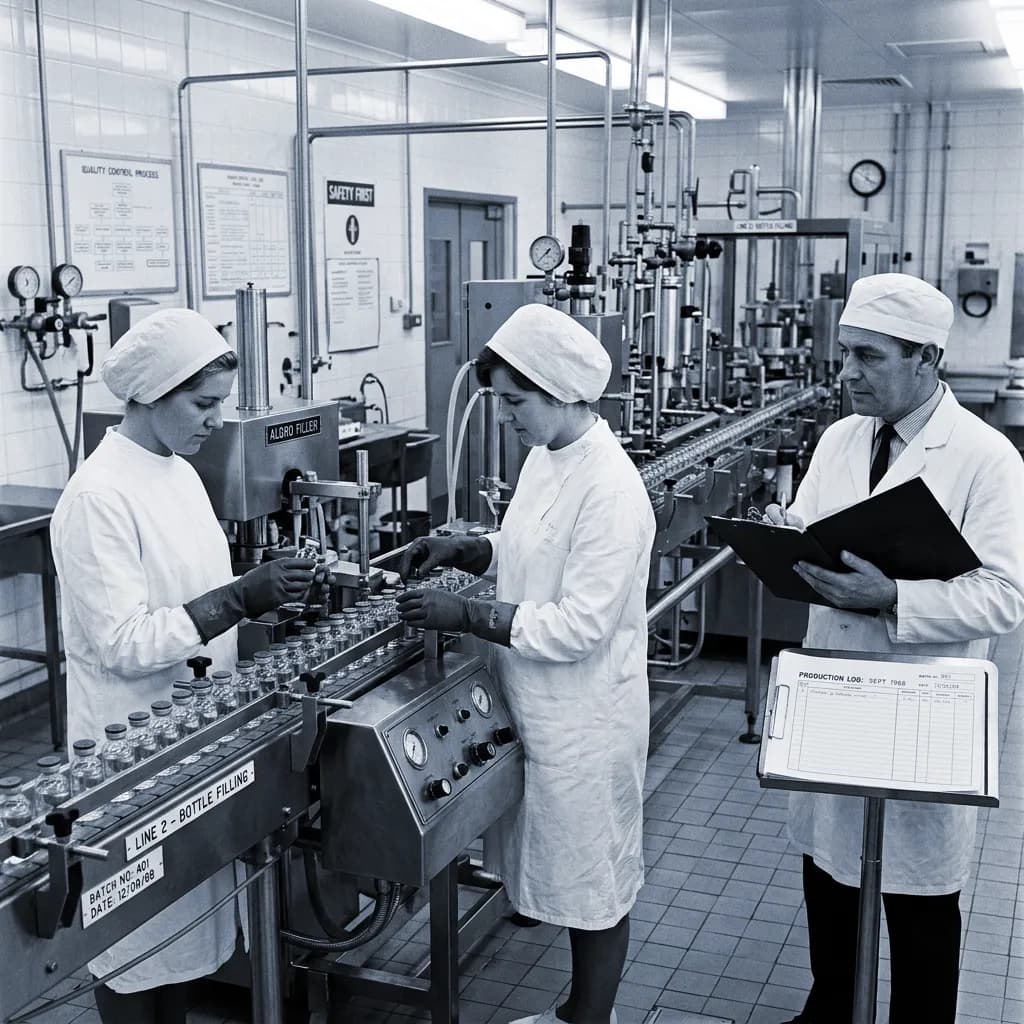
What does GMP compliance consulting deliver when pharma and biotech manufacturers have to build their manufacturing under the EU GMP Guide and 21 CFR 211 so that it holds up under a regulatory inspection?
Our GMP consulting supports manufacturers of medicinal products, active substances and sterile products toward GMP compliance under EU GMP Guide and 21 CFR Part 210/211. As long as deviation, CAPA and change control systems do not interlock, gaps surface only at inspection, when there is no time to fix them.
Overview
What does GMP require of manufacturers in practice?
Support from gap analysis to inspection · EU GMP Guide Part I/II & Annexes, 21 CFR Part 210/211, ICH Q7, Q9(R1), Q10
Last updated: October 4, 2026
Good Manufacturing Practice under the EU GMP Guide (EudraLex Volume 4) and 21 CFR Part 210/211 is mandatory for manufacturers of medicinal products, active substances and sterile products, as well as for CDMOs, contract manufacturers and importers.
- Outdated SOPs and specifications fail to keep pace with the current state of the EU GMP Guide and the ICH guidelines, so that documented and actual practice drift apart.
- The quality management system under ICH Q10 is in place, but deviation management, CAPA and change control are not linked. Findings are addressed, but root causes are not closed out systematically.
- Sterile manufacturing is run against the revised Annex 1 without the required Contamination Control Strategy in place as a coherent document.
- Qualification and validation under Annex 15 are started too late in a scale-up or with a new facility, so that process validation slows down the production start instead of safeguarding it.
Services
How we support you
GMP training & qualification
Training of production, QA and QC personnel on GMP fundamentals, hygiene, documentation obligations and deviation management, with verifiable training records for the personnel file. Also available as in-house training.
How we work together
What it comes down to
A GMP system rarely fails because of a single missing process. It fails because the processes that exist do not refer to one another. The GMP gap analysis against the EU GMP Guide (EudraLex Volume 4) and 21 CFR Part 211 flags up front which gap is critical, before SOPs are written and equipment is qualified.
Only then is it worth building the quality management system under ICH Q10: SOPs, batch records and release processes form the framework into which deviation management, CAPA and change control are hooked.
Specifically, deviation management, CAPA and change control must interlock, because an inspector does not check whether a deviation was documented, but whether its root cause has been demonstrably closed, underpinned by Quality Risk Management under ICH Q9(R1).
The most common bottleneck arises further downstream, in qualification and validation under Annex 15 and in the computerised systems under Annex 11. A site that starts process validation only shortly before the production start turns it into a bottleneck, because without a validated process no batch may be released to the market.
That is why we pull the validation master plan and the data integrity concept forward: in the inspection, the same gap becomes a critical finding and pushes the project back by months. In sterile manufacturing, the revised Annex 1 comes into play, requiring the individual hygiene measures to be combined into a coherent Contamination Control Strategy.
Around this system sit the individual topic fields, each with its own page. Anyone looking to commission a GMP audit, at a supplier, a contract manufacturer or their own site, gets there via GxP audits; how such an assessment is prepared is set out in the article on GxP audit preparation.
The dry run under inspection conditions is what mock audits provide, the preparation for the official date is inspection readiness. On the facility side, GMP facility qualification and CQV and cleanroom qualification carry out qualification under Annex 15, while computer system validation covers the validation of computerised systems under Annex 11.
For the data this produces, 21 CFR Part 11 and data integrity and data integrity assurance under ALCOA+ apply. Sterile manufacturing is dealt with separately under Annex 1.
Our approach
Our approach
Step
Result
GMP gap analysis
Prioritized action plan: where the system stands relative to the EU GMP Guide and 21 CFR Part 211, what is critical, and what is a matter of effort.
QMS build-up & documentation
SOP structure, batch records, specifications and release processes under ICH Q10, documented and controlled.
Deviation & CAPA system
Interlinked processes for deviation, CAPA and change control with risk assessment under ICH Q9(R1) in operation.
Qualification & validation
Validation master plan and completed qualification/process validation under Annex 15.
Mock inspection & training
Simulated EMA/FDA inspection, prepared team, trained personnel with documented records.
Regulatory inspection & follow-up
Supported inspection, structured resolution of the findings via a scheduled CAPA plan.
Common pitfalls
Where projects commonly fail
Deviation management is decoupled from the CAPA system.
Deviations are documented but not translated into corrective and preventive actions; during the inspection it becomes apparent that the same root cause recurs. That is a classic trigger for a critical finding.
The SOPs do not reflect actual practice.
When processes are carried out differently from what is described, a gap opens up between documentation and reality that an inspector exposes immediately during the walkthrough via the personnel interview.
In sterile manufacturing, the coherent Contamination Control Strategy is missing.
The revised EU GMP Annex 1 requires a consistent, overarching strategy; individual hygiene measures without connecting logic count as a gap, not as evidence.
Qualification and validation under Annex 15 start too late.
If process validation is only tackled shortly before the planned production start, it becomes the bottleneck, because without a validated process no batches may be released to the market.
Computerised systems are operated without a data integrity concept.
If the audit trail, access rights and validation under Annex 11 are missing, EMA and FDA flag the integrity of the GMP-relevant data regardless of the quality of the production itself.
Quality Management & Compliance
Do any of these pitfalls apply to you?
In a first call we assess your situation and say what needs clarifying first in your case. Without obligation, reply usually within one working day.
FAQ
Frequently asked questions
Sources
- EU GMP Guide (EudraLex Volume 4), Part I, Part II, Annex 1, Annex 11, Annex 15
- Directive (EU) 2017/1572, principles and guidelines of good manufacturing practice for medicinal products for human use (replaces Directive 2003/94/EC)
- 21 CFR Part 210/211, Current Good Manufacturing Practice for Finished Pharmaceuticals
- ICH Q7, Q9(R1), Q10, GMP for active substances, Quality Risk Management, Pharmaceutical Quality System
Image notice: The images on this page were generated using artificial intelligence. They do not depict real people, places, or events.
Life Science Journal
Regulatory updates, straight to your inbox.
New requirements, authority decisions and practice notes. Once a month, unsubscribe any time.
Case Studies
What this looks like in practice


More projects on this topic
- Audit Support: Securing Reliable Audit Results→
- Building a Supplier Management System with Continuous Monitoring→
- Cost Optimization of Tablet Production→
- Fill-and-Finish Turnaround in Sterile Manufacturing→
- IT Support Backlog Cleared and GMP Lab Relocated→
- Optimizing Cleaning Validation for Complex Product Lines→
- Optimizing the Entire QC Laboratory Environment→
- Quality Management for Process Stability and Compliance in a Pharmaceutical Production Line→
- Uninterrupted QP Coverage After a Short-Notice Absence→
Related insights
All insights →Regulations & standards considered
- EU GMP Guide (EudraLex Volume 4)
- EU GMP Guide Part I (medicinal products for human use)
- EU GMP Guide Part II (active substances / APIs)
- EU GMP Guide Annex 1 (manufacture of sterile medicinal products)
- EU GMP Guide Annex 11 (computerised systems)
- EU GMP Guide Annex 15 (qualification and validation)
- Directive (EU) 2017/1572 (GMP principles for medicinal products for human use)
- 21 CFR Part 210 (cGMP, general principles)
- 21 CFR Part 211 (cGMP, finished pharmaceuticals)
- ICH Q7 (GMP for active substances)
- ICH Q9(R1) (Quality Risk Management)
- ICH Q10 (Pharmaceutical Quality System)
Related topics
GxP Audits (GMP, GLP, GCP) →
Commission GMP audits at suppliers, contract manufacturers and your own site
Mock Audits →
A dry run under inspection conditions before the authority arrives
Inspection Readiness →
Preparation for EMA and FDA inspections as the follow-on step
Computer System Validation (CSV) →
Validation of computerised systems under Annex 11
Annex 1 (Sterile Manufacturing) →
GMP requirements for sterile manufacturing in detail
Have a concrete project?
Briefly outline your situation. We'll respond with an initial assessment, usually within one business day.
Prefer direct? +49 89 4161170-0
info@theentourage.de
- Reply usually within one working day
- 4 offices: DE · CH · IT · US
- 100% life sciences